Content
1. Understanding Patterns of Sports Injuries
3. Analyzing Sport-Specific Injury Patterns
4. Preventative Measures and Rehabilitation
5. Advanced Techniques in Injury Prevention
6. Injury Management Strategies
7. Technological Advancements and Injury Prevention
8. Conclusion
For millions of people worldwide, sports with their thrilling rush and fierce competitiveness are the cornerstone of physical exercise and enthusiasm. Nevertheless, despite the excitement and skill, playing sports has its drawbacks, the most significant of which is the possibility of sports injuries. Because of the nature of the activity, the motions involved, and the amount of effort needed, these injuries frequently follow a certain pattern. Healthcare workers, coaches, and athletes must all comprehend these patterns.
Common Types of Sports Injuries
In different games, injuries and strains are among the most widely recognized wounds. Tendon injuries happen when tendons are extended or torn, while muscle strains are brought about by overextending or tearing muscle strands. Competitors who play sports like football, b-ball, and soccer, which require unexpected, savage developments or quick heading changes, are habitually survivors of these wounds.
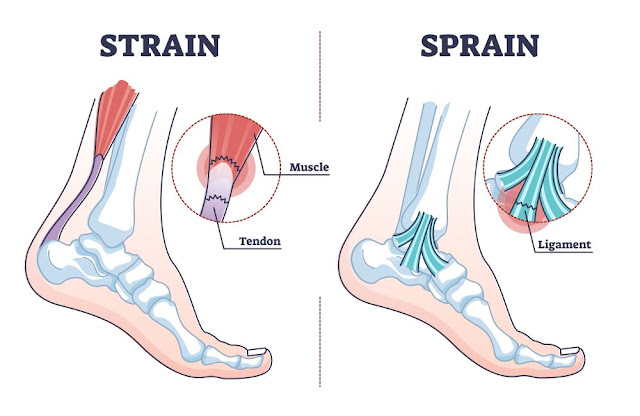 |
| Strains and Sprains
|
Broken bones, or fractures, are another major sports-related problem. Impact-driven sports, like martial arts or rugby, can result in falls or collisions that break bones. Repetitive activity such as sprinting or leaping can result in stress fractures, which are tiny breaks in the bone.
 |
| Fractures |
3. Tendonitis
Tendonitis, or inflammation of the tendons, is common in sports like baseball, tennis, and golf that require repetitive actions. Certain tendons that are overused might become painful and swollen, which can impair function and necessitate rest and rehabilitation.
 |
| Tendonitis |
When bones inside a joint are pushed out of their natural placements, it results in a dislocation. Dislocations are common in sports like gymnastics and wrestling because they entail strong stretching or impact and can result in acute pain and limited range of motion.
 |
| Dislocations |
A kind of severe brain damage called a concussion is becoming more and more of an issue in contact sports like boxing, football, and hockey. These injuries, which frequently result from hits to the head, cause physical and mental symptoms that call for emergency medical care.
 |
|
|
Analyzing Sport-Specific Injury Patterns
Because every sport has distinct injury patterns, specific prevention measures and recovery techniques are required.
1. Football
Because of the sudden direction changes and numerous collisions, football is a high-impact activity that frequently results in ligament tears, concussions, and muscular strains.
2. Tennis
Tennis players are more likely to develop tendonitis in their elbows or shoulders as a result of their repeated actions, which can affect their serve and overall game.
3. Gymnastics
Gymnastics, which emphasizes strength and flexibility in its motions, can cause dislocations of the shoulders or wrists as a result of excessive stretching and landing force.
Preventative Measures and Rehabilitation
1. Prevention
A multifaceted strategy including appropriate warm-ups, conditioning activities, enough rest, and technique improvement is needed to prevent sports injuries. To lessen injury risks and teach players techniques to reduce them, coaches and trainers are essential.
2. Rehabilitation
Athletes must undergo rehabilitation after an injury to compete at their best again. This stage entails a customized program overseen by medical specialists that includes strengthening exercises, physical rehabilitation, and a gradual return to sport-specific activities.
1. Biomechanical Analysis
Advanced technologies, such as biomechanical analysis and motion capture, provide valuable insights into athletes’ gait patterns. This makes it possible to identify possible stress spots and injury-prone regions, allowing for the creation of specialized training regimens to address these weaknesses.
2. Periodization in Training
Periodization is the application of planned training cycles that alternate between high-intensity training sessions and recuperation intervals. By doing so, an athlete’s performance can be maximized while the danger of overuse injuries is decreased.
3. Sports-Specific Conditioning
Strength, flexibility, and endurance that are unique to an athlete’s activity may be developed by designing conditioning routines to match the demands of the sport. This focused training lowers the risk of injury during competition.
Injury Management Strategies
1. R.I.C.E. Protocol
A mainstay of early injury care, the R.I.C.E. protocol (Rest, Ice, Compression, Elevation) successfully lowers pain and swelling following an accident.
2. Advanced Methods of Rehabilitation
Athletes’ recuperation times have been considerably faster in recent years because of improvements in rehabilitation treatments. Advanced physiotherapy techniques, cryotherapy, and laser treatment are examples of technologies that speed up healing and improve functional recovery.
3. Psychological Rehabilitation
It’s critical to acknowledge the psychological effects of injuries. Since
mental health issues are common among recovering athletes, including psychological counseling in rehabilitation plans promotes athletes’ overall healing.
Technological Advancements and Injury Prevention
1. Technology Wearables
The development of wearable technology, such as smart gadgets and sensors, makes it possible to track an athlete’s body mechanics and performance in real time. These insights make it possible to identify anomalies that may cause harm early on.
2. Instruction with Virtual Reality
Virtual reality (VR) training reduces the chance of harm while enhancing skills and decision-making abilities by giving athletes a secure environment in which to practice and replicate game situations.
Conclusion
All in all, while sports offer an elating road for active work and energy, they additionally present inborn dangers of wounds. Understanding these injury designs and their pervasiveness across different games is urgent for medical services laborers, mentors, and competitors the same.
The normal sorts of sports wounds envelop strains, hyper-extends, breaks, tendonitis, disengagements, and blackouts, each predominant in unambiguous exercises because of the idea of developments and effect included.
Examining sport-explicit injury designs requires custom-fitted counteraction procedures and recuperation methods. Football, tennis, and vaulting, among others, show particular injury patterns requiring centered consideration.
Protection measures envelop a complex methodology including warm-ups, molding, rest, and procedure refinement. Recovery, administered by clinical experts, is pivotal for competitors to recapture ideal execution following a physical issue.
High-level strategies like biomechanical examination, periodization in preparation, and sports-explicit molding help in injury avoidance. They target shortcomings and adjust preparing to match sport-explicit requests, lessening injury chances.
Injury-the-board techniques like the
R.I.C.E. convention, high-level restoration strategies, and mental help are vital in upgrading recuperation and lessening free time for competitors.
Mechanical progressions, including wearable tech for ongoing observing and computer-generated reality preparing for expertise upgrades in a protected climate, have arisen as powerful instruments in injury counteraction and ability improvement inside the domain of sports.
Tendonitis